



What Is Low-Acid Coffee? How It's Made, Why It Matters, and What to Look For
Low-acid coffee is exactly what it sounds like: coffee that's less acidic than regular coffee. But what that means in practice, how it's measured, how different brands achieve it, and whether it actually makes a difference for your stomach, is where most explanations fall short.
Here's the full picture.
What "Low-Acid" Actually Means
Coffee contains acids. A typical cup from a major brand sits between 4.8 and 5.3 on the pH scale. For context, that's less acidic than orange juice (around 3.5) but more acidic than black tea (around 4.9) and significantly more acidic than water (neutral at 7.0).
The pH scale is logarithmic, which matters here. Each whole number represents a tenfold change in acidity, so the difference between 5.0 and 5.5 isn't just 10%, it's closer to 3x the acidity. Small-seeming pH differences are real differences.
"Low-acid coffee" typically refers to coffee with a pH of 5.5 or higher. The higher the number, the less acidic.
The organic acids in coffee, chlorogenic acid, quinic acid, citric acid, and others, form during roasting and extraction. They contribute to flavor (brightness, complexity) and they contribute to the stomach irritation that makes coffee a problem for people with acid reflux, GERD, or a sensitive stomach. Reducing those acids changes both things: less irritation, and a flavor profile that tastes smoother and less sharp.
Where Coffee's Acids Come From
Coffee's acid content isn't a single thing. It's the sum of several organic acids that develop at different stages:
During growing: The altitude and soil composition where beans grow affects baseline acidity. Beans grown at higher elevations tend to produce more acidic coffee; beans from lower elevations (Brazil, Sumatra) tend toward lower acidity naturally.
During roasting: Acids break down at high temperatures. Dark roasts lose more of it than light roasts, which is why dark roasts tend to taste less bright and acidic. Roasting also produces N-methylpyridinium, a compound that may reduce stomach acid secretion.
During brewing: Hot water extracts more acids from grounds than cold water does. Cold brew, which steeps grounds in cold water for 12–24 hours, consistently tests 0.3–0.5 pH units higher (less acidic) than the same beans brewed hot.
The result: A light-roasted bean from a high-altitude Ethiopian farm, brewed hot, will be significantly more acidic than a dark-roasted Brazilian bean made as cold brew. Same category, very different pH.
The Different Ways Brands Achieve "Low-Acid"
Not all low-acid coffee gets there the same way. The mechanism matters, because it affects what you're getting.
Natural origin selection. Some brands source beans from regions that naturally produce lower-acid coffee, like Brazil, Sumatra, Peru, and southern Mexico. Lower altitude, volcanic soil, and climate conditions create beans with less acidity built in. This is real but modest. You're not going to get a dramatically different pH just from bean origin.
Dark roasting. More roasting time breaks down more acid. A dark roast from any brand will be less acidic than a light roast from the same brand. But most major brands don't publish pH data, and "dark roast" is not the same as "low-acid". A dark Dunkin' roast still measures around 5.0, lower than most specialty low-acid products.
Cold brewing. The most consistent method for reducing acids. Cold water extracts fewer acids over time. Cold brew typically tests 0.3–0.5 pH units higher than hot-brewed coffee. The tradeoff is flavor profile (distinctly different from hot coffee) and the change to your brewing ritual.
Steam or chemical processing. Some brands use post-harvest processing to reduce acidity. This is where the methods diverge sharply. Some use chemical processes. trücup uses an all-natural water-and-steam process (no chemicals or additives) that specifically reduces the acids responsible for stomach irritation while preserving the rest of the flavor profile and caffeine.
How Low Acid Coffee Is Measured (and Why Most Brands Skip This)
The right way to verify whether a coffee is actually low acid is a pH test, by an independent, third-party lab measurement. Most brands don't publish this because "low acid" is a marketing claim, not a regulated category, and the phrase can be applied to any coffee without verification.
What independent lab testing on common coffee brands shows:
|
Brand |
pH |
|
trücup |
5.74 |
|
Folgers |
5.37 |
|
Starbucks |
5.08 |
|
Dunkin' Original Blend |
5.02 |
trücup's 5.74 pH means it's roughly 60% less acidic than Dunkin' or Starbucks on the pH scale. That's not a marketing claim. It's the math of how logarithmic scales work.
If you're evaluating any low-acid coffee brand, the question to ask is simple: does the brand publish a specific pH number from independent testing? If the answer is "our coffee is naturally smooth and gentle on the stomach," that's marketing. If the answer is a number from an outside lab, that's data.
Who Benefits from Low Acid Coffee
People with acid reflux. Coffee triggers reflux through two mechanisms: the acids in coffee irritate the esophagus when acid travels upward, and caffeine weakens the lower esophageal sphincter (LES), making reflux more likely. Low-acid coffee addresses the first mechanism directly. A full breakdown is in our coffee and heartburn guide.
People with GERD. Gastroesophageal reflux disease, or chronic reflux, more than twice a week, is one of the most common reasons people give up coffee. Switching to a lower-acid option doesn't treat the underlying condition, but it removes one of the most consistent daily triggers. More detail in our coffee for acid reflux guide.
People with a sensitive stomach. Even without diagnosed reflux, some people find that regular coffee causes nausea, stomach discomfort, or general GI irritation. Lower-acid coffee is often gentler in these cases. The mechanism is the same (less acid), even if the underlying condition isn't the same.
People with tooth sensitivity. Acidic foods and drinks contribute to enamel erosion over time. A coffee with 5.74 pH is meaningfully less corrosive than one at 5.0 with daily exposure, though coffee's effect on tooth enamel is generally modest compared to soda or citrus.
People who just want a smoother cup. Low-acid coffee tends to taste smoother and less sharp. There's less brightness and bite. For people who add cream and sugar specifically to cut bitterness and harshness, a low-acid coffee often requires less doctoring.
Low Acid Coffee vs. Regular Coffee: What Changes
Flavor: Less brightness, less sharp acidity. Smoother finish. Depending on the roast, the dominant notes shift toward chocolate, nuts, and earthiness rather than fruit and citrus. The tradeoff (if you call it that) is a cup that drinks more easily.
Caffeine: Caffeine content is not affected by the acid-reduction process. trücup's low-acid coffee contains the same caffeine as any comparable roast. If you also want to reduce caffeine (for its LES-relaxing effect), that's a separate variable, addressed by half-caff.
Health associations: The coffee health research tracks "coffee drinkers" as a category, and studies on Parkinson's risk, liver health, and Type 2 diabetes don't distinguish between high-acid and low-acid coffee. The benefits are associated with regular coffee consumption generally. What low-acid coffee does is keep people in the "regular coffee drinker" category who would otherwise have had to quit due to stomach issues. More on what the research shows is in our coffee health benefits article.
Low-Acid Coffee in K-Cup Form
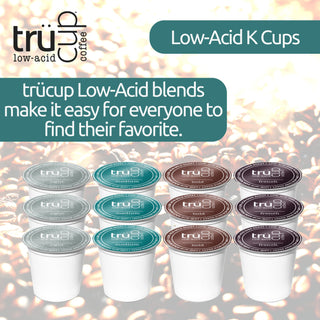
Low-acid coffee isn't limited to bagged ground coffee or whole beans. trücup's full line is available in K-Cups compatible with all Keurig brewers, and the acid-reduction process is the same, using the same water-and-steam treatment, same 5.74 pH, same result as the bagged version. If you're using a Keurig and want to reduce the acid in your morning cup without changing machines, the trücup K-cups are the direct option.
How to Choose a Low-Acid Coffee
A few criteria that matter:
1. Does it have a published pH number? Not a claim, a number. From outside testing. This is the most important filter.
2. How is the acidity reduced? Processing method (like water-and-steam), natural origin, roast level, or cold brewing are all real, but they produce different results, and the marketing language often obscures which one you're getting.
3. Does it come in the format you actually want? Ground coffee, whole beans, K-cups, decaf. Low-acid options are more limited than the general coffee market, so format matters when you're making the switch.
4. What does the flavor profile look like? Roast level still varies within the low-acid category. trücup offers Bold, Medium, Light, and French Roast, all at the same 5.74 pH, with different flavor profiles depending on what you're looking for.
For a side-by-side comparison of the major low-acid brands and what their actual numbers look like, our best low acid coffee brands guide has the full breakdown.
Frequently Asked Questions
What is low acid coffee?
Low acid coffee is coffee with a higher pH than regular coffee, typically 5.5 or above. Regular coffee from major brands sits between 4.8 and 5.3. The lower acidity comes from the beans, the roast, the brewing method, or a specific processing technique (like trücup's water-and-steam process). Lower pH means fewer of the organic acids that cause stomach irritation for people with acid reflux or GERD.
Which coffee is lowest in acid?
Among independently tested brands, trücup measures at 5.74 pH, which is higher than Folgers (5.37), Starbucks (5.08), or Dunkin' (5.02). Cold brew made from low-acid beans can test even higher, but most comparisons are for hot-brewed coffee. The key is to look for a brand that publishes actual pH data from outside testing.
Does low acid coffee have less caffeine?
No. Caffeine content is independent of acidity. Processing methods that reduce acid don't change caffeine levels. If you want to reduce caffeine alongside acidity, half-caff or decaf low-acid options address both variables separately.
Is low acid coffee actually better for acid reflux?
For acid-driven reflux, yes. The mechanism is direct. Lower acid coffee means less esophageal irritation when reflux occurs. For caffeine-driven reflux (caffeine relaxes the LES), low-acid alone doesn't solve it. You also need to reduce caffeine. Many people with GERD have both mechanisms at play, which is why a low-acid, half-caff combination addresses more of the problem than changing one variable at a time.
What coffee is easiest on your stomach?
Low-acid coffee that's been specifically processed for acid reduction and tested to verify it. Among measured options, trücup at 5.74 pH is at the top end. Cold brew from any brand also tests higher than hot coffee. Dark roasts are lower-acid than light roasts within the same brand, though the brand-to-brand difference is usually larger than the roast-to-roast difference.
Is low acid coffee the same as dark roast?
No. Dark roasts are lower in acid than light roasts, because longer roasting breaks more of it down. But "dark roast" and "low acid" aren't the same category. A dark roast Dunkin' still measures around 5.0 pH. Low-acid coffees that have been specifically processed for acid reduction test significantly higher, even in lighter roasts.
What is the best coffee for fatty liver?
Research consistently associates regular coffee consumption with lower rates of liver disease and cirrhosis. This is one of the more robust findings in the coffee health literature, found across multiple large studies. The research tracks coffee drinkers generally, not low-acid coffee specifically. But the implication is that staying a regular coffee drinker matters, and for people who've reduced or quit coffee due to acid reflux or GERD, low-acid coffee is the path to staying in that category.
Can you get low acid coffee in K-Cups?
Yes. trücup makes low-acid K-cups in Bold, Medium, Light, and French Roast — all independently tested at 5.74 pH and compatible with all Keurig brewers.
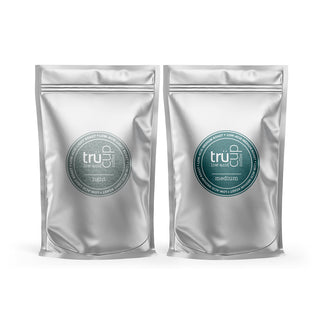
If you want to try low-acid coffee before committing to a full bag, trücup's sample packs include multiple roasts. Same water-and-steam process, same 5.74 pH, without buying a full bag first.