



Why is Coffee Giving Me Heartburn
If coffee gives you heartburn, you've probably already tried the obvious fixes. Antacids after your morning cup. Switching to a lighter roast because you read somewhere that it's gentler. Drinking more water. Eating something first.
Some of those help. Some don't. And most of the advice you'll find online either tells you to quit coffee entirely or offers vague suggestions without explaining the actual mechanism.
Here's what's actually happening, and which variables are worth changing.
What Heartburn Is (and What It Isn't)
Heartburn is a symptom, not a condition. It's the burning sensation in your chest or throat that happens when stomach acid travels up into the esophagus — the tube connecting your throat to your stomach. The name is misleading: nothing is wrong with your heart.
The valve that normally keeps acid in your stomach is called the lower esophageal sphincter (LES). When it weakens or relaxes at the wrong time, acid escapes. That's reflux. Heartburn is what it feels like.
Occasional heartburn after a big meal or a stressful day is common and not a cause for concern. If it happens more than twice a week, that moves into acid reflux or GERD (gastroesophageal reflux disease) territory, a chronic condition worth managing more deliberately. Coffee can trigger heartburn in either scenario, but the mechanisms are slightly different.
The Two Ways Coffee Triggers Heartburn
Coffee doesn't cause heartburn through one mechanism. It causes it through two, simultaneously.
First: the acids in coffee irritate the esophagus directly. Coffee contains multiple organic acids (chlorogenic, quinic, citric, and others) that form during the roasting process. When those acids travel up with reflux, they're corrosive to the esophageal lining in a way that plain water isn't. The lower the pH of your coffee (the more acidic), the more irritating this effect is.
Regular coffee from most major brands sits between 5.0 and 5.2 pH. Dunkin' Original Blend measures 5.02, Starbucks 5.08, Folgers 5.37. For reference, water is neutral at 7.0, and because pH is a logarithmic scale, each full point represents a tenfold difference in acidity. Even the difference between 5.0 and 5.5 is meaningful.
Second: caffeine relaxes the lower esophageal sphincter. This is separate from the acid issue entirely. Caffeine weakens the LES's ability to stay closed, which means stomach acid can escape even when it wouldn't otherwise. This is why some people find that decaf coffee is gentler on their stomach. Not because it's less acidic, but because it removes the caffeine trigger.
If both mechanisms are at play for you, changing only one of them may not be enough. That's worth knowing before you spend months experimenting with one variable at a time.
Can Caffeine Cause GERD and Heartburn?
Yes — and the mechanism is different from what most people assume. Caffeine doesn't cause heartburn by adding more acid to your stomach. It causes it by weakening the lower esophageal sphincter (LES), the valve that keeps stomach acid from traveling upward.
When caffeine enters your system, it relaxes smooth muscle tissue throughout the body, including the LES. A weaker LES closes less completely, which means stomach acid can escape into the esophagus more easily, even if your stomach's acid level is normal. This is why coffee can trigger reflux from coffee even when nothing else has changed: the valve isn't holding, not because there's more acid than usual.
Can caffeine cause GERD? Not in isolation. GERD involves a structural or physiological weakness in the LES that has multiple contributing causes. But if you already have that predisposition, caffeine can turn occasional reflux into the more frequent, more severe pattern associated with GERD.
A few signs caffeine is your primary trigger:
- You get heartburn from coffee but not from the same amount of decaf
- Stronger cups or more cups correlate directly with worse symptoms
- You also get symptoms from energy drinks, strong tea, or pre-workout supplements
- Symptoms tend to arrive 30–60 minutes after coffee rather than immediately (the LES effect is slightly delayed compared to direct acid irritation)
If caffeine is the main driver, reducing it through a half-caff or decaf option addresses more of the problem than switching to a lower-acid coffee alone. For many people with GERD, both are contributing factors, which is why a half-caff low-acid combination addresses more of the problem than changing just one variable.
The Variables You Can Actually Control
Coffee acidity. The most direct lever. Some coffees have significantly less acid than others. They aren't just marketed that way, but tested and measured. trücup uses a natural water-and-steam process to reduce acidity, bringing their coffee to a measured 5.74 pH. That's roughly 60% less acidic than Dunkin' or Starbucks. For someone whose heartburn is primarily acid-driven, this is the highest-impact change they can make.
A full breakdown of which brands have actual pH data and which are just marketing is in our best low acid coffee brands comparison.
Caffeine level. If caffeine is also a trigger (and for many people with GERD, it is), a half-caff or decaf option lets you reduce that variable independently of acidity. The two are often conflated. People assume "low acid" means less caffeine, or that decaf means less acid. Neither is automatically true. They're separate, and it's possible to adjust either one without touching the other.
trücup's half-caff addresses both. It's processed the same way as their regular coffee, so you get the 5.74 pH alongside 50% less caffeine.
Roast level. Dark roasts tend to be lower in chlorogenic acid than light roasts, because the longer roasting process breaks more of those acids down. Dark roasts also contain more N-methylpyridinium, a compound that research suggests may suppress excess stomach acid secretion. So between a light roast and a dark roast from the same brand, the dark roast is generally the better bet for a sensitive stomach, though the brand-to-brand pH difference still matters more than the roast difference within a single brand.
Brew method. Cold brew is the lowest-acid brewing method because cold water extracts fewer acids from the grounds over time. Studies consistently show cold brew registers 0.3–0.5 pH higher (less acidic) than the same beans brewed hot. The tradeoff is flavor. Cold brew has a different profile than hot coffee, and not everyone prefers it. If you want the acid advantage without changing your brewing ritual, switching to a low-acid bean processed specifically for acid reduction gets you most of the way there without giving up your drip machine or Keurig.
Timing. Coffee on a completely empty stomach makes heartburn more likely. There's nothing to buffer the acid, and your stomach lining is more exposed. Even a small amount of food first makes a real difference. Separately, lying down within two to three hours of your cup is one of the most reliable ways to trigger reflux, because gravity stops working in your favor.
What you add. Cream, heavy cream, and some artificial sweeteners are independent reflux triggers for some people. If you've switched to low-acid coffee and still have symptoms, the add-ins are worth examining. On the other side, oat milk or regular dairy milk actually raises the overall pH of your cup slightly, a small but real buffer if you're sensitive.
The Best Coffee for GERD, Heartburn, and Reflux
If you have GERD or frequent heartburn and aren't ready to give up coffee, the best coffee is one that's been specifically processed to reduce acid levels, not just described as "smooth" or "easy on the stomach," but independently tested and measured.
For GERD specifically, the acid variable matters more than marketing language. Most coffee sits at 5.0–5.2 pH. A low-acid coffee that's been genuinely engineered for acid reduction like trücup, which measures at 5.74 pH from independent lab testing, reduces the direct esophageal irritation that conventional coffee causes. For people whose GERD symptoms are acid-driven, that difference is often enough to keep coffee in their daily routine.
Low-acid coffee for GERD isn't a cure and isn't a substitute for medical management if your symptoms are severe. But for the common pattern of acid-aggravated GERD, it removes one of the most consistent daily triggers.
What the options look like:
- Low acid coffee for GERD: Look for independently tested pH data, not marketing language. trücup at 5.74 pH is one of the few brands with published numbers from outside testing.
- Best coffee for heartburn and reflux: Same criteria; verified low pH, water-based processing, no chemical additives. Dark roasts from a low-acid brand give you the additional advantage of reduced chlorogenic acid from the extended roast.
- Decaf coffee for GERD: Decaf removes the LES-relaxing caffeine effect, but standard decaf is still as acidic as regular coffee. Low-acid decaf (or half-caff) addresses both triggers simultaneously.
- GERD coffee substitute: If you want to reduce coffee intake rather than just switch brands, our GERD coffee alternatives guide covers chicory, mushroom coffee, cold brew, and herbal substitutes in detail.
Drinking Coffee with GERD
GERD (gastroesophageal reflux disease) is chronic reflux: symptoms happening more than twice a week, often with more intensity and duration than occasional heartburn. Coffee is one of the most commonly cited GERD triggers, and many gastroenterologists recommend reducing or eliminating it as part of GERD management.
That advice is reasonable. But it often gets interpreted as "coffee causes GERD", and that's too broad. Coffee can worsen GERD symptoms in people who already have the condition. It doesn't create the underlying structural issue (a weakened LES or hiatal hernia) in the first place.
For people drinking coffee with GERD, the question is whether you can reduce the variables that aggravate symptoms without eliminating coffee entirely. The evidence suggests most people can:
- Switching to lower-acid coffee reduces direct esophageal irritation during reflux episodes
- Reducing caffeine (half-caff or decaf) reduces the LES-weakening effect
- Avoiding coffee on an empty stomach and not lying down afterward reduces the mechanical conditions that worsen reflux
- Limiting to one or two cups per day lowers the cumulative acid load
- Choosing a dark roast over a light roast from the same brand reduces chlorogenic acid content further
For some GERD sufferers, any amount of coffee is a problem and stopping is the right answer. But for most people with mild to moderate GERD, these changes, especially switching to a lower-acid option, make staying a coffee drinker realistic. More on what the research says is in our coffee for acid reflux guide.
What Doesn't Actually Help (Much)
Drinking alkaline water with your coffee. Occasionally recommended online. The stomach is highly acidic (around pH 2), and a small amount of alkaline water doesn't meaningfully change that. It won't neutralize the acids in your coffee before they can cause reflux.
Grinding coarser. A coarser grind does extract slightly fewer acids. The effect is small enough that it's not worth counting on as a primary strategy.
Switching to espresso. Espresso is often thought to be higher-acid because it's more concentrated. In reality, because the serving size is much smaller, the total acid load per cup is often lower than a standard drip coffee. But most people don't drink espresso in a 12-oz format. And if you're adding milk and sugar to a latte, other variables come into play.
When to Stop Troubleshooting and Talk to a Doctor
Most coffee-related heartburn responds to the changes above, especially switching to lower-acid coffee and reducing caffeine if needed. But if heartburn is happening more than twice a week despite diet changes, or if you're experiencing difficulty swallowing, unexplained weight loss, or chest pain that feels different from typical heartburn, those symptoms warrant a conversation with a doctor rather than another variable swap.
Persistent, untreated acid reflux can cause changes to the esophageal lining over time (Barrett's esophagus), which is worth monitoring. This is a separate issue from the coffee question, but it's worth flagging.
Frequently Asked Questions
Does coffee cause heartburn?
Coffee can cause heartburn through two mechanisms: the organic acids it contains irritate the esophagus when reflux occurs, and caffeine relaxes the lower esophageal sphincter, making reflux more likely in the first place. Not everyone is equally susceptible. Individual LES tone, overall diet, and other factors determine how strongly coffee affects a given person.
Can caffeine cause heartburn?
Yes. Caffeine relaxes the lower esophageal sphincter (LES), the valve between your esophagus and stomach, making it easier for stomach acid to escape upward. This is separate from coffee's acid levels. It's why decaf can be gentler for some people even at the same pH level.
Does coffee cause GERD?
Coffee doesn't create GERD. The underlying condition involves a structurally weakened LES with multiple contributing causes. But coffee aggravates GERD symptoms in many people, primarily through its acid content and caffeine's LES-relaxing effect. Switching to lower-acid, lower-caffeine coffee often reduces symptom frequency without requiring full abstinence.
Is coffee bad for heartburn?
It can be, but it depends on what you're drinking and how. High-acid coffee, drunk on an empty stomach, in large amounts is a reliable recipe for symptoms. Low-acid coffee, with food, in moderate amounts is much less so for most people.
What coffee is easiest on the stomach?
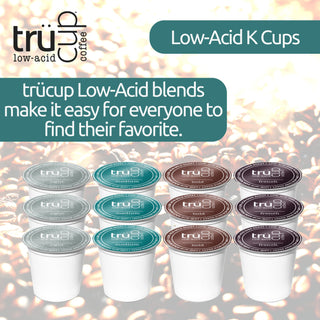
Low-acid coffee that's been specifically processed to reduce pH and tested to verify it. trücup measures at 5.74 pH from independent lab testing. In the single-serve format, their K-cups work in any Keurig and carry the same acid reduction as the bagged version.
Can switching coffee brands actually reduce heartburn?
For acid-driven heartburn, yes — switching to a meaningfully lower-acid coffee is one of the most direct interventions available. The key is choosing a brand with actual pH data, not just a "smooth" or "gentle" label. The difference between 5.02 pH (Dunkin') and 5.74 pH (trücup) is real and measurable.
Why is coffee giving me heartburn all of a sudden?
A few things explain sudden coffee sensitivity after years without symptoms: LES tone weakens with age, certain medications (NSAIDs, calcium channel blockers, some antidepressants) reduce LES pressure as a side effect, weight gain increases abdominal pressure, and dietary changes can create a cumulative trigger load that coffee then pushes over the threshold. More detail on each of these is in our coffee for acid reflux guide.
What's the relationship between coffee and GERD?
Coffee is one of the most commonly cited GERD triggers, primarily because of its acid content and caffeine's LES-relaxing effect. That said, the research is more nuanced than most popular advice suggests. Some studies find only modest associations between coffee and GERD symptoms, and individual tolerance varies widely. For chronic GERD sufferers, low-acid and low-caffeine coffee options let you keep the ritual while reducing the most controllable triggers.
Does quitting coffee fix heartburn?
For many people, yes. Removing the trigger removes the symptom. But quitting isn't the only option. The question is whether coffee itself is the problem or whether the specific coffee you're drinking is. Switching to a low-acid option often resolves the issue without requiring full abstinence.
Coffee and heartburn don't have to be a package deal. The connection is real, but it's also more specific than most people realize — and most of the variables that drive it are ones you can change.
Try a trücup sample and see if lower acid is what your stomach was reacting to all along.