



The low acid coffee category has gotten crowded. A few years ago there were maybe three brands worth knowing about. Now there are dozens, and most of them carry some version of the claim "gentle on your stomach," "smooth," "easy to digest", without much to back it up.
That's a problem if you have acid reflux or GERD and you're actually trying to manage symptoms, not just buy a bag with softer marketing language.
This guide covers what to actually look for when comparing low acid coffee brands, which ones have earned the designation, and what makes some options genuinely better than others.
What "Low Acid" Actually Means (and What It Doesn't)
First, the thing nobody says clearly: "low acid" isn't a regulated term. Any brand can use it. There's no threshold it has to clear, no certification body checking the claim, no standard definition it has to meet.
Low Acid Coffee Brands Compared by Measured pH
Most "low acid" claims aren't backed by a number. We had ours tested and published the result, alongside five widely available supermarket coffees measured the same way. Higher pH means less acid.
| Brand | Product tested | Measured pH |
|---|---|---|
| trücup | Light Roast | 5.74 |
| Seattle's Best | #2 | 5.52 |
| Folgers | Classic Roast | 5.37 |
| Millstone | Breakfast Blend | 5.22 |
| Starbucks | Aria Blonde | 5.08 |
| Dunkin' | Original Blend | 5.02 |
How we tested
Samples were measured by Coffee Analysts in 2016. Each coffee was brewed at 2.75 oz coffee to 60 oz. water using standard drip brewer at 203 degrees f, and read with a calibrated pH meter across multiple samples per coffee.
What the numbers mean
The pH scale is logarithmic, so the gaps are larger than they look. At 5.74, trücup measures roughly 71% less acid than the average of the five supermarket coffees above, and about 81% less than the most acidic one tested.
Some brands earn the label by choosing naturally lower-acid growing regions (high-altitude, volcanic soil, certain origins). Some use cold brew processing. Some use steam or other treatments to reduce acids. A few have their coffee independently tested in a lab and publish the pH data. Most don't.
Acid in coffee is measured by pH. The scale runs from 0 to 14. The lower the number, the more acidic. Water is 7 (neutral). Regular coffee sits at 5.0–5.5 depending on the brand. Dunkin' Donuts Original Blend measures 5.02, Starbucks Aria Blonde comes in at 5.08, Folgers at 5.37, Seattle's Best at 5.52. For people with acid reflux, the relevant question isn't whether a coffee is technically "low acid" but how its actual pH compares to what they're currently drinking.
If a brand won't tell you its measured pH, that's information. It either hasn't tested, or the numbers aren't impressive enough to share.
What to Look for in a Low Acid Coffee Brand
Before getting to specific brands, here are the criteria worth applying:
Lab-tested pH. The best brands publish their pH data, ideally from independent testing. A claim of "60% less acid" should be accompanied by actual numbers, not just marketing copy.
Natural process. Chemical treatments and additives can reduce acid levels, but they can also affect flavor. All-natural acid reduction processes, whether through origin, roasting, or a proprietary method, tend to produce a cleaner result.
Roast range. If a brand only offers one roast, that limits how useful it is. Good low acid coffee should be available in multiple roasts (light, medium, dark, decaf) so you can find one that suits your taste without compromising on acid reduction.
Transparent sourcing. Brands that talk openly about where their beans come from and how they process them tend to be more trustworthy than those that keep the details vague.
Format options. Ground, whole bean, K-cups...if you have a preferred brewing method, the brand needs to support it.
The Brands Worth Knowing
trücup
trücup is one of the few brands in this category with independently tested, published pH data. Their coffee comes in at 5.74 pH, tested by an outside lab, not self-reported. Against the brands above (5.02–5.52), that's roughly 60% less acid.
The process uses only water and steam (no chemicals, no additives) to remove harmful acids from 100% Non-GMO premium arabica beans. The flavor stays intact. Bold is still bold, dark is still dark, which matters because a lot of "low acid" coffees taste like the acid reduction was the only thing they were thinking about.
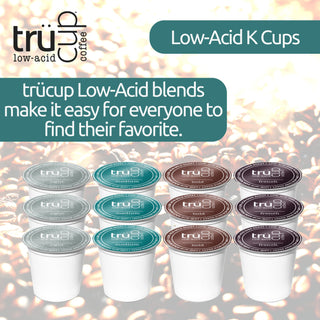
trücup offers six roasts: light, medium, bold, French roast, espresso, and half-caff. They also have low acid K-Cups for Keurig ($47.95 for 48 K-cups, about $1.00 per cup). The range is wide enough that you can match your current coffee preference to a low-acid equivalent rather than compromising.
Best for: People who want verified pH data and a full range of roasts. Also a good pick if you're managing both acid and caffeine sensitivity (the half-caff is genuinely useful).
Purity Coffee
Purity markets itself primarily around mycotoxins and pesticide testing. Their angle is "the healthiest coffee" more broadly, with low acid as one of several claims. They use specialty-grade, organic beans from specific origins known for naturally lower acidity. The sourcing story is strong and well-documented.
The tradeoff is price. Purity is expensive, and the focus on health credentials can make it feel more like a supplement than a morning ritual. The roast options are more limited than some brands.
Best for: People who prioritize organic certification and broad health testing alongside acid reduction.
Volcanica Coffee
Volcanica sources beans from volcanic regions, where the soil composition tends to produce naturally lower-acid coffee. They have a wide range of origins and roasts, and they've built a real reputation in the specialty coffee world. Their low acid line is a subset of a much larger catalog.
The acid reduction here comes from origin selection rather than additional processing, which is a legitimate approach, but it means the acid levels vary more between their offerings than brands that apply a consistent process to all their beans.
Best for: Coffee enthusiasts who want origin-specific variety and are willing to experiment to find the right roast.
Java Planet
Java Planet (JP Organic) is USDA organic certified and focuses on low acid beans from specific origins. They've built a following among people looking for organic low acid coffee at a more accessible price point than Purity. The selection is solid and they're one of the more visible brands in this space.
Best for: People who want organic certification and a reasonable price.
Tyler's Coffee
Tyler's bills itself as "acid-free", a stronger claim than most. They use a proprietary Z-Roasting™ process that prevents tannic and lipid acids from developing during roasting, resulting in a coffee they say is up to 50% less acidic than conventional brands. It's a legitimate approach, and effective for people with significant acid sensitivity. The tradeoff is flavor complexity. The aggressive acid reduction can produce a cup that tastes smoother but flatter, which not everyone prefers.
Best for: People with significant acid sensitivity who prioritize symptom relief over flavor complexity.
VitaCup
VitaCup is a functional-coffee brand (vitamin-infused, mushroom, collagen, "Slim," "Genius") that also sells a plain "Perfect Low Acid" dark roast. That one is just organic arabica from Honduras and Guatemala with nothing added, which is the version worth considering here. The low-acid claim rests on the dark roast and high-altitude sourcing; VitaCup doesn't publish a pH or a percentage. It comes as Keurig-compatible pods only, in 16-count boxes at $26.95 on their site (about $1.68 per cup) or 18-count at Walmart and Target for around $23 ($1.28 per cup). There's a decaf version and a blueberry-flavored one.
Best for: Keurig users who want a low-acid pod they can grab at Walmart or Target today. If you want to compare measured acidity, or you drink anything lighter than a dark roast, this isn't the one.
Lifeboost Coffee
Lifeboost is the most heavily marketed low-acid coffee in the country, and if you've searched the category you've seen their ads. Their pitch is purity: single-origin Nicaraguan beans, USDA organic at the farm, and third-party testing for mycotoxins, heavy metals, pesticides, and glyphosate. Low acid is one claim among many. They say the coffee is "pH lab tested" and "up to 27.7% less acidic than common store-bought coffees," but they don't publish the pH number itself, and the acidity reduction comes from bean selection and roast rather than any processing step. Roasts: light, medium, dark, decaf, half-caff, plus a wide flavored line and mushroom blends. They do sell Keurig-compatible pods, but only in 10-count boxes at $21.99, which works out to about $2.20 per cup, more than double most brands in this guide.
Best for: People who want organic certification and a long list of contaminant tests, and who are willing to pay a premium for the brand. If measured acidity is the priority, look for a brand that publishes the number.
Puroast
Puroast has the strongest acidity claim on this list after trücup, and unlike most brands they back it with a number: 5.82 pH, which they say was verified by UC Davis and North Carolina A&T. Their process is a patented high-heat roast that converts the quinic and chlorogenic acids into other compounds, and they also claim the roast yields several times the antioxidants of regular coffee. The trade-off is that the method works best on darker roasts, so the lineup skews dark: French roast, Italian espresso roast, a house blend, decafs, and flavored varieties. There's no light roast. Bags run large (20 oz at $29.50 to $31.50, 2.5 lb at $45.50 to $58.50, roughly $19 per pound), and single-serve pods come in 24-count boxes at $32.50, about $1.35 per cup. Puroast is also one of the few low-acid brands you'll find on a grocery shelf, and it's on Amazon.
Best for: Dark-roast drinkers who want a published pH and a lower price per pound than the specialty organics. Not for anyone who prefers a light or medium cup.
Lucy Jo's Coffee Roastery
Lucy Jo's is a small New York roaster whose "Mellow Belly" line has a loyal following on Amazon. Everything is USDA certified organic, and the low-acid approach is origin-based: Sumatran and other Indonesian beans, wet-hulled and roasted medium-dark, which produces an earthy, low-brightness cup that many sensitive drinkers tolerate well. Lucy Jo's doesn't publish a pH figure. The only third-party number we've found is 5.27, from Low Acid Coffee Certification Standards Association data cited by a competitor, which would put it below the 5.5 threshold most people use for "low acid" and closer to a conventional dark roast. Take that with the source in mind. The range is wide for a small roaster: Mellow Belly original, dark, breakfast, half-caff, and decaf, plus single origins from Peru, Brazil, Sumatra, Flores, and Java, all ground or whole bean from $23.75 per bag. No K-cups or pods.
Best for: People who want organic, a smooth dark cup, and a small-roaster feel, and who drink from a drip or pour-over rather than a Keurig.
What About Grocery Store Options?
If you've searched "low acid coffee in grocery stores," you're not alone. It's one of the most common related searches in this category. The honest answer is that the pickings are thin. Folgers makes a low acid blend, and Trader Joe's has carried one at various times, but neither has published pH testing data and both are essentially marketing repositioning of conventional coffee.
They may be easier on your stomach than what you're currently drinking. But they're not going to give you the kind of verified, consistent acid reduction you'd get from a brand that built its entire product around this problem.
If you want to try before committing to an online order, trücup samples are available, a lower-commitment entry point than a full bag.
Frequently Asked Questions
Which coffee brand is the least acidic? Among brands with independently published pH data, trücup's 5.74 pH is one of the lowest measured numbers you'll find. Tyler's "acid-free" claim goes further, but uses a roasting process that changes the flavor significantly.
What is the best low acid coffee for seniors? Seniors often have more sensitive digestive systems and may also be managing medications that interact with caffeine. A low-acid or half-caff option tends to work best, covering both the acid and caffeine variables simultaneously.
Is Folgers low acid coffee actually low acid? Folgers does make a "Simply Smooth" blend marketed for stomach comfort, but they haven't published independent pH testing for it. It may be somewhat gentler than their standard coffee, but it's not in the same category as brands specifically engineered for acid reduction.
Is low acid coffee good for GERD? For most people with GERD, yes. The acids in coffee are a primary trigger, and reducing them meaningfully reduces symptoms. That said, caffeine is also a factor; it relaxes the lower esophageal sphincter independently of acid. Low-acid coffee addresses one variable; low-acid plus lower caffeine addresses both.
How do I find low acid coffee that actually works? Look for brands that publish their pH data from independent testing. If a brand is vague about how they achieve "low acid" or won't give you a number, the marketing is probably doing more work than the coffee.
The low acid coffee market is worth navigating carefully. The brands that have put real work into acid reduction and can prove it, aren't hard to identify once you know what to ask for. Start with the pH data. Everything else follows from there.
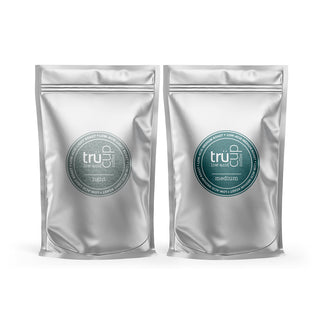
trücup is available as low acid K-Cups and ground coffee bags, both independently tested at 5.74 pH.