



Most people with acid reflux have been told the same thing: coffee is a trigger, so stop drinking it. It's not bad advice, exactly. Coffee does trigger reflux in a lot of people. But "stop drinking coffee" treats all coffee as equivalent, which isn't accurate, and it treats quitting as the only option, which it usually isn't.
Low Acid Coffee Brands Compared by Measured pH
Most "low acid" claims aren't backed by a number. We had ours tested and published the result, alongside five widely available supermarket coffees measured the same way. Higher pH means less acid.
| Brand | Product tested | Measured pH |
|---|---|---|
| trücup | Light Roast | 5.74 |
| Seattle's Best | #2 | 5.52 |
| Folgers | Classic Roast | 5.37 |
| Millstone | Breakfast Blend | 5.22 |
| Starbucks | Aria Blonde | 5.08 |
| Dunkin' | Original Blend | 5.02 |
How we tested
Samples were measured by Coffee Analysts in 2016. Each coffee was brewed at 2.75 oz coffee to 60 oz. water using standard drip brewer at 203 degrees f, and read with a calibrated pH meter across multiple samples per coffee.
What the numbers mean
The pH scale is logarithmic, so the gaps are larger than they look. At 5.74, trücup measures roughly 71% less acid than the average of the five supermarket coffees above, and about 81% less than the most acidic one tested.
The more useful questions are: why does coffee cause acid reflux, does all coffee do it equally, and what can you actually change to keep drinking it without the symptoms? That's what this guide is for.
Acid Reflux and GERD: What's the Difference?
These terms get used interchangeably but they describe different things. The distinction matters when you're deciding how seriously to manage your coffee habits.
Acid reflux is the event: stomach acid travels up into the esophagus, causing the burning sensation most people recognize as heartburn. It can be triggered by specific foods or drinks, a heavy meal, lying down too soon after eating, or stress. Occasional acid reflux a few times a month is common and not a medical concern on its own.
GERD (gastroesophageal reflux disease) is chronic acid reflux: symptoms more than twice a week, persistent enough to cause inflammation or damage to the esophageal lining over time. GERD is a diagnosable condition that may require medical management, not just diet changes.
For occasional reflux, switching to lower-acid coffee and adjusting a few habits is usually enough to eliminate the problem. For GERD, those same changes are still worth making, but they're part of a broader management approach. Either way, understanding what coffee is doing to your system is the starting point.
Why Does Coffee Trigger Acid Reflux?
Coffee causes acid reflux through two separate mechanisms that often work simultaneously.
The acids in coffee irritate the esophagus directly. Coffee contains organic acids; chlorogenic, quinic, citric, and others formed during roasting. When acid reflux occurs, these travel up into the esophagus, which (unlike the stomach) isn't designed to handle acid. The more acidic the coffee, the more irritating this effect.
Coffee acidity is measured in pH. The scale runs from 0 to 14, with 7 being neutral. Regular coffee sits between 5.0 and 5.2 depending on the brand. Dunkin' Original Blend measures 5.02, Starbucks 5.08, Folgers 5.37. Because pH is logarithmic, each full point represents a tenfold difference in acidity. Even the gap between 5.0 and 5.5 is meaningful when your esophagus is the thing absorbing it.
Caffeine relaxes the lower esophageal sphincter (LES). The LES is the valve between your esophagus and stomach. When it stays closed, stomach acid stays in the stomach. Caffeine weakens that valve's resting tone, making it more likely to open at the wrong time and let acid escape upward. This happens independently of coffee's pH. It's a separate mechanism with a separate fix (reducing caffeine rather than acidity).
Many people with acid reflux have both problems at once, which is why switching to a less acidic coffee helps some but not all symptoms, and why decaf helps some but not all symptoms. Addressing both together is usually more effective than picking one.
Does All Coffee Cause Acid Reflux?
No. And this is where most popular advice oversimplifies things.
Coffee's effect on acid reflux varies based on what you're drinking and how. The same person who gets reflux from a light-roast drip coffee may have no symptoms from a low-acid dark roast with food. The mechanism is real, but the dose and the form matter.
Several factors determine how much acid ends up affecting your stomach and esophagus:
The bean and process. Most coffee sits at 5.0–5.2 pH. Some brands specifically engineer their coffee to reduce acidity, and the difference is measurable. trücup uses a natural water-and-steam process (no chemicals) that brings their coffee to 5.74 pH. That's roughly 60% less acidic than conventional coffee. For a sensitive stomach, that gap is the difference between symptoms and no symptoms.
Roast level. Darker roasts are generally lower in acid than lighter roasts. The extended roasting process breaks down more of those acids. Dark roasts also contain more N-methylpyridinium, a compound research suggests may actually help suppress excess stomach acid secretion. So a dark roast from the same brand will typically be gentler than a light roast.
Brewing method. Cold water extraction pulls fewer acids from coffee grounds than hot water. Cold brew consistently registers 0.3–0.5 pH higher (less acidic) than hot-brewed coffee from the same beans. Pour-over and drip fall in the middle. Espresso, counterintuitively, delivers less total acid per serving because of its small volume, though most espresso-based drinks involve milk, which introduces other variables.
Caffeine content. As discussed, caffeine relaxes the LES regardless of acidity. High-caffeine coffee, especially in large amounts, is more likely to trigger reflux even if the pH is reasonable.
Timing and quantity. Coffee on an empty stomach means no food buffer between the acid and your stomach lining. Three cups of coffee is a higher acid load than one cup, even if each cup is the same. Lying down within two to three hours of drinking coffee means gravity is no longer helping keep acid in the stomach.
None of these factors exist in isolation. Switching to a lower-acid coffee while drinking it on a full stomach in moderate amounts is very different from switching to a lower-acid coffee and otherwise maintaining every other trigger.
The New York Times take
A few years ago the New York Times published an article on the correlation between eating highly acidic foods and acid reflux, heartburn, and other ills. The article highlighted the recent health claims that eating a low-acid diet can help those who suffer from these types of stomach problems.
In the study, 12 men and 8 women with reflux symptoms who hadn’t responded to medication were put on a low-acid diet for two weeks, eliminating all foods and beverages with a pH lower than 5. The lower the pH, the higher the acid content; highly acidic foods and beverages include diet sodas (2.9 to 3.7), strawberries (3.5) and barbecue sauce (3.7). According to the study, 19 out of 20 patients improved on the low-acid diet, and 3 became completely asymptomatic.”
The Best Coffee for Acid Reflux
For people managing acid reflux, the priority is coffee that's been specifically processed to reduce pH, not just roasted dark or marketed as "smooth." The distinction matters because claims are unregulated: any brand can call its coffee "low acid" without any threshold to clear or testing to back it up.
The brands worth knowing are ones that publish actual pH data from independent testing.
trücup measures at 5.74 pH, tested by an outside lab, not self-reported. The process uses only water and steam to remove harmful acids from non-GMO arabica beans, with no chemical additives. The result is a meaningfully lower-acid coffee that still tastes like coffee: bold is still bold, dark is still dark. They offer six roasts (light, medium, bold, French roast, espresso, half-caff), so you can find a low-acid equivalent of whatever you currently drink rather than compromising on flavor.
For a full side-by-side of the major low-acid brands, see our best low acid coffee brands comparison. It covers what each brand has actually published, not just what their marketing says.
Decaf Coffee for Acid Reflux
Switching to decaf is one of the most common recommendations for acid reflux, and it's partially right. Decaf removes caffeine, which, as discussed, independently relaxes the LES and contributes to reflux. So decaf coffee does remove one of coffee's two main reflux mechanisms.
The catch: decaf is not automatically low-acid. A decaf coffee made from conventional beans using conventional processing will still have a pH around 5.0–5.2. It won't weaken your LES as much, but when reflux does occur, the acid in the coffee is still there irritating your esophagus.
For the most effective acid reflux management, you want coffee that addresses both variables; lower acid and lower caffeine. trücup's half-caff does exactly that: it's processed the same way as their regular coffee (5.74 pH), but with 50% less caffeine. It lets you reduce both triggers simultaneously rather than trading one for the other.
Cold Brew Coffee for Acid Reflux
Cold brew is genuinely lower in acid than hot-brewed coffee, and the evidence is consistent. When coffee is brewed with cold water over a long extraction period, fewer acids are pulled from the grounds compared to hot water brewing. Studies show cold brew registers 0.3–0.5 pH higher than hot-brewed coffee from identical beans.
For acid reflux sufferers, that difference is real and worth noting. Cold brew made from low-acid beans would theoretically give you the lowest-acid result possible, stacking both the process advantage and the bean advantage.
The practical tradeoffs: cold brew requires preparation time (or a subscription), has a different flavor profile than hot coffee (many people describe it as smoother and less bright), and not everyone prefers it as a daily ritual. If cold brew works for you, it's a solid option. If you want a hot cup in the morning without switching your whole routine, starting with low-acid beans and brewing them hot still gets you most of the way there.
Why Is Coffee Giving Me Heartburn All of a Sudden?
This is a common experience: you've been drinking the same coffee for years, and then at some point it starts causing problems. A few explanations:
Your body has changed. The lower esophageal sphincter weakens with age, making reflux more likely. Hormonal changes (including pregnancy) affect LES tone. Certain medications, particularly NSAIDs, calcium channel blockers, and some antidepressants, reduce LES pressure as a side effect. Weight gain, especially around the abdomen, increases pressure on the stomach. Any of these can turn a previously tolerable coffee habit into a problematic one.
Your coffee has changed. If your usual brand reformulated, changed their roast profile, or you switched to a different product without noticing, the pH or caffeine content may have shifted. A new bag that's a lighter roast than what you were buying before would explain sudden symptoms even if everything else stayed the same.
Your diet has changed. Coffee's effect on acid reflux interacts with everything else you eat. If you've recently started eating more spicy food, alcohol, fatty foods, or chocolate, all of which also trigger reflux, coffee that was previously tolerable may now be part of a cumulative load that's tipping you over the threshold.
Your stress levels have changed. Stress doesn't directly cause acid reflux, but it affects how sensitively people perceive symptoms and influences gut motility. A period of elevated stress can make existing, previously subclinical reflux suddenly noticeable.
If the sudden heartburn is new, it's worth checking whether any of these variables have shifted before assuming the coffee itself needs to go.
How to Drink Coffee Without Getting Acid Reflux
Even with a lower-acid coffee, a few habits make a consistent difference:
Eat something first. Even a small amount of food before your first cup buffers the acid and reduces direct contact with the stomach lining. This is especially relevant for the morning cup, which often happens on a completely empty stomach.
Don't lie down for two to three hours after drinking. Gravity plays a real role in keeping stomach acid where it belongs. Drinking coffee and then getting back into bed, or drinking with a meal and then lying down for a nap, removes that gravitational advantage.
Add oat milk or dairy milk. Both raise the pH of your cup slightly. It's a modest adjustment, but for people who are especially sensitive, it adds a small buffer to every sip.
Limit to one or two cups. Acid load accumulates. One cup of low-acid coffee may be fine; three may not be, even if each cup is gentler than your previous coffee. Start with one and find your threshold.
Use a larger cup setting on single-serve machines. Brewing with less water concentrates the acid per sip. The 8–10oz setting gives you a more diluted, gentler result than the 6oz setting.
Adjust your add-ins. Cream, high-fat creamers, and some artificial sweeteners are independent reflux triggers for some people. If you've switched coffees and still have symptoms, examine what's going into the cup.
For more detail on habits and what the research says about coffee and acid reflux, see our guide to coffee and heartburn.
The Coffee-Acid Reflux Myth Worth Correcting
The popular claim that coffee inherently causes acid reflux and therefore all coffee drinkers with GERD must quit, overstates what the research actually shows.
A 2019 meta-analysis published in PMC examined the relationship between coffee and reflux symptoms across multiple studies and found associations, but not consistent evidence that coffee causes erosive esophagitis (the structural damage associated with chronic GERD). A number of studies show individual tolerance varies so widely that blanket avoidance recommendations aren't universally supported by gastroenterologists.
What the research does support is that high-acid coffee, in large quantities, on an empty stomach, from someone with an already-weakened LES is likely to cause symptoms. Change enough of those variables, especially the acid levels and the amount, and many people with acid reflux can continue drinking coffee without problems.
This doesn't mean coffee is harmless for everyone with GERD. For some people, any coffee is a problem. But the evidence doesn't support the categorical advice to quit, and it's worth testing your specific situation rather than accepting the blanket rule.
When to See a Doctor
Diet changes, including switching to low-acid coffee, are a reasonable first step for mild, occasional reflux. But certain symptoms call for medical evaluation rather than continued self-management:
- Heartburn or reflux symptoms more than twice a week, especially if they don't improve with diet changes
- Difficulty or pain when swallowing
- Unexplained weight loss
- Persistent nausea or vomiting
- Chest pain that differs from the usual heartburn burning sensation
- A feeling of food getting stuck in your throat or chest
These can indicate more serious esophageal issues, including Barrett's esophagus (a precancerous change in the esophageal lining that can result from untreated chronic GERD). If you're in this category, coffee management is part of the picture but a doctor's evaluation is the priority.
Frequently Asked Questions
What is the best coffee for acid reflux?
Low-acid coffee that has been specifically processed to reduce pH and tested to verify it. trücup measures at 5.74 pH from independent lab testing, one of the lowest verified numbers in the category. For context, that's compared to 5.02 for Dunkin' and 5.08 for Starbucks.
Can I drink coffee with acid reflux?
Most people can, with the right coffee and habits. Switching to a lower-acid variety, drinking with food, and staying upright afterward resolves symptoms for many people who were previously told to quit entirely.
Is dark roast coffee better for acid reflux?
Generally yes, relative to light roast from the same brand. Dark roasts have less acid (broken down during roasting) and more N-methylpyridinium, a compound that may suppress excess stomach acid. But the brand-to-brand difference in pH still matters more than the roast difference within a single brand.
What can I add to coffee to reduce acid reflux?
Oat milk or dairy milk both raise the overall pH of your cup slightly. Eating food with or before your coffee buffers stomach acid. Avoiding high-fat creamers and artificial sweeteners removes other potential triggers from the equation.
If you've been managing acid reflux by avoiding coffee, timing antacids around your morning cup, or just suffering through symptoms you assumed were unavoidable, it's worth finding out whether the coffee itself is the problem or just the version you've been drinking.
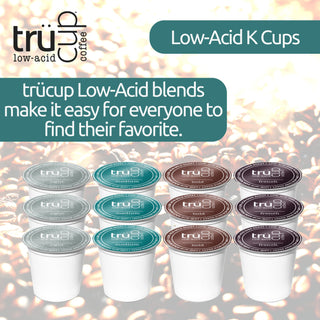
Try a trücup sample pack before committing to a full bag. For single-serve convenience, the K-cup version carries the same acid reduction as the bagged coffee. It's the same process, same pH, same result.