



Ask which coffee is easiest on your stomach, and you'll get a dozen confident answers, most of them from brands selling coffee.
The harder question is how you'd know. Almost every low-acid brand describes itself as smooth, gentle, or stomach-friendly. Very few attach a number to it. Fewer still say who measured.
So instead of ranking brands by marketing copy, here's a comparison built on what each one actually discloses.
The Three Things That Determine Whether Coffee Bothers You
Coffee irritates stomachs through more than one mechanism, which is why "less acid" isn't a complete answer.
Acid Content is the obvious one. Coffee's acids contribute to the pH of your cup, and lower pH generally means more potential for irritation. Standard drip coffee lands around 5.0 on the pH scale.
Caffeine relaxes the lower esophageal sphincter, the muscle that keeps stomach contents where they belong. For people with reflux, this matters independently of acids. A pH-perfect coffee with normal caffeine can still cause problems.
Compounds beyond acid.
Research on steam-treated coffee has identified phenolic compounds associated with gastric irritation that aren't captured by a pH reading at all. Two coffees with identical pH can affect people differently based on what else survived processing.
Most brand comparisons only address the first one. Keep the other two in mind as you read.
How Brands Actually Reduce Acid in Coffee
There are four common approaches, and they're not equivalent.
Dark roasting
This is the most common method, and the cheapest. Extended roasting degrades acids, producing a coffee that tastes less bright and tangy. The pH change is modest, typically 0.1 to 0.2 points.
Brands using this approach are honest about it more often than not, describing their coffee as a dark roast selected for smoothness. That's a fair claim. What's less fair is charging a low-acid premium for a roast profile that any roaster can produce.
Low-altitude sourcing
Beans from Brazil, Sumatra, and other low-elevation growing regions carry less acid than high-altitude Ethiopian or Colombian varieties. Volcanica Coffee's low-acid blend, which lists a pH of 5.3 on its product page, uses Brazilian and Sumatran arabica for this reason.
This is a real difference, but a small one, and it's a sourcing decision rather than a process. The beans were always going to be lower in acid.
Cold brew
Genuinely produces a lower-acid result through low-temperature, slow extraction. The limitation is that it's a brewing method, not a product. Any beans brewed cold produce a milder cup, which means a "low acid cold brew" is describing how you made it, not what you bought.
Steam treatment of green beans
This is the least common and the only one that changes the bean before roasting. Green coffee is treated with steam and water, which breaks down acids and removes its decomposition products before the beans ever reach the roaster.
The process dates to a 1933 German patent by P. Lendrich. It was analyzed in peer-reviewed research published in Food Chemistry in 1979, which found the treatment reduced not only measurable acid levels but also phenolic compounds researchers associated with stomach irritation. The same paper cited clinical work from the early 1970s finding lower gastric acid secretion in people drinking steam-treated coffee.
trücup uses this method with proprietary modifications.
Why the pH Number Is Bigger Than It Looks
A common mistake, including in some brand marketing, is treating pH differences as linear. They aren't.
The pH scale is logarithmic. Each whole number represents a tenfold change in hydrogen ion concentration. So the gap between 5.0 and 5.74 isn't a 14 percent improvement — it's roughly 60 percent less acid.
That's the difference between a number that sounds trivial and one that reflects a real change in the chemistry of what you're drinking.
It also means the reverse is true. A brand advertising a pH of 5.1 versus standard coffee's 5.0 is describing a difference of about 20 percent, and one that most people won't detect.
What to Actually Ask Before You Buy
Four questions cut through nearly all of the marketing.
Is there a pH number, and who measured it? A brand that tests its own product and publishes the result is more credible than one that doesn't test. A brand that uses a 3rd party is more credible still. No number at all means you're evaluating adjectives.
Does the caffeine change? Legitimate acid reduction doesn't affect caffeine. If a brand's low-acid option has noticeably less caffeine than its regular coffee, something other than acid is being removed.
What's the actual process? "Specially roasted" and "carefully sourced" describe purchasing and roasting decisions. Steam treatment of green beans, chemical-free water processing, and similar interventions describe something done to the bean. Both can produce a better cup. Only one changes the chemistry before roasting.
Does the brand tell you what it doesn't do? Java Planet's FAQ states plainly that no third party confirms its acidity levels. That's an unusual thing to publish, and it's more trustworthy than a vague claim would be. Transparency about limits is a reasonable proxy for transparency generally.
Where trücup Lands
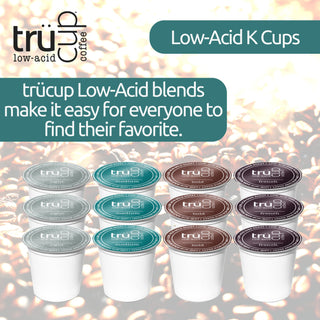
trücup's process treats green coffee with water and steam before roasting, based on the Lendrich method with proprietary modifications developed by trücup. No chemicals, no solvents, no caffeine reduction.
An independent 3rd party tested the result at 5.74 pH. It's roughly 60 percent less acid than Starbucks (5.08) or Dunkin' (5.02).
There is full caffeine, every roast; light, medium, bold, French, espresso blend, as well as half-caff for people who want less caffeine without losing the cup entirely.
None of that is a health claim. It's a measurement, taken by someone other than us, that you can compare against anyone else's number. T
The Short Version
Most brands claiming to be easy on your stomach are describing a roast profile. A few are describing a process. The way to tell them apart is to ask for a number and find out who measured it.
References Van der Stegen, G.H.D. (1979). The effect of steaming and de-waxing of green coffee on the coffee brew. Food Chemistry, 4, 23–29. Rösner, P. et al. (1971). Med. Klin., 66(7), 238. Sziegoleit, W. et al. (1972). Pharmazie, 27(12), 768. Lendrich, P. (1933). D.P.S. 576515.