



If you have acid reflux or GERD, you’ve likely heard one piece of advice: quit coffee. Every medical site, every reflux forum, every well-meaning article eventually lands there. Give it up. Drink herbal tea. Move on.
For a lot of people, this advice is a non-starter. If you've been drinking coffee every morning for twenty years, "just quit" lands about as well as "just don't be stressed."
Here's what those articles aren't telling you: not all coffee is created equal, and definitely not with respect to acid levels. The acid content in coffee varies significantly depending on how the beans are roasted, how the coffee is brewed, and whether it's been processed to reduce acids. For people with acid reflux or GERD, switching to a lower-acid coffee is often enough to keep symptoms manageable, without giving up the cup entirely.
This guide covers why coffee causes heartburn, what makes some coffees easier on your stomach than others, and how to find one that actually works.
Why Coffee Causes Heartburn in the First Place
Coffee contains several organic acids (chlorogenic, quinic, citric) and when you drink it, two things happen. First, those acids irritate the lining of the esophagus directly. Second, caffeine relaxes the lower esophageal valve, the regulator that keeps stomach acid where it belongs. When that valve loosens, acid creeps up. That's reflux.
The pH scale measures acidity from 0 to 14, with 7 being neutral (water). The lower the number, the higher the acid content. Regular coffee sits around 5.0–5.5 pH depending on the brand. Dunkin' Donuts Original Blend measures 5.02, Starbucks Aria Blonde at 5.08, Folgers at 5.37. For context, each whole point on the pH scale represents a tenfold difference in acidity, so even fractions of a point matter more than they look.
The good news is that pH varies between coffees. And for people with sensitive stomachs, even a modest reduction in acid content can make a real difference.
What Makes Some Coffees Easier on Your Stomach
There are four main factors that affect how much acid ends up in your cup.
Roast level. Darker roasts tend to be lower in acids than lighter roasts. The longer and hotter the roasting process, the more those acids break down. Light roasts retain more of them. So if you're choosing between a dark French roast and a bright light roast and you have acid reflux, the dark roast is generally the safer bet, assuming everything else is equal.
Brewing method. Cold brew coffee is extracted at room temperature over many hours, which pulls fewer acids from the grounds than hot water brewing. Studies consistently show cold brew has a higher pH (less acid) than the same beans brewed hot.
Cold water extracts differently than hot water. Heat is a more efficient solvent, pulling a wider range of compounds from the grounds, including volatile aromatics that contribute to the bright, complex top notes in coffee. Cold brew extracts primarily the heavier, more soluble compounds over its long steep time, which is why cold brew tastes smooth and chocolatey but often lacks the floral, fruity, or citrusy brightness that hot-brewed specialty coffee can deliver.
Pour-over and drip fall somewhere in the middle. Espresso, counterintuitively, is often lower in total acid volume than drip because the serving size is so much smaller.
Processing. Some coffee brands go further and use a specific process, natural or otherwise, to actively reduce acid content before the coffee ever reaches you. This isn't about pH tricks or additives; it's about how the beans are handled. trücup, for example, uses a natural water-and-steam process (no chemicals) that brings their coffee to a measured 5.74 pH, about 60% less acidic than conventional coffee. That's a meaningful reduction for anyone whose stomach notices the difference.
Caffeine level. Caffeine itself (separate from acid) relaxes the esophageal valve. So for some people with GERD, even low-acid coffee causes problems if the caffeine load is high. Half-caff and decaf options exist precisely for this situation. And if you're choosing a low-acid coffee, having a half-caff version available gives you another variable to adjust.
The 2-Hour Coffee Rule — Does It Help?
You may have seen this floating around: wait two hours after waking before you drink coffee. The idea is that cortisol, your body's natural wake-up hormone, peaks in the first hour or so after you get up. Drinking coffee during that window supposedly blunts the effect and leaves you more dependent on caffeine. Some versions of the rule apply to GERD: wait two hours after a meal before drinking coffee so your stomach has time to start emptying.
Does it help? For some people, yes. Drinking coffee on a full (or at least not completely empty) stomach does reduce acid's direct contact with the stomach lining. But the 2-hour rule addresses timing, not the underlying acid content of what you're drinking. It's a useful habit, but it's treating the symptom rather than the source. Switching to a lower-acid coffee does more.
Is There a Coffee That Doesn't Cause Heartburn?
The short answer is that no coffee is completely acid-free. But "doesn't cause heartburn" and "acid-free" aren't the same thing. For most people with acid reflux, the threshold isn't zero. It's lower than what regular coffee delivers.
Low-acid coffee processed specifically to reduce acid content is the closest thing to a genuine answer here. trücup is one of the few brands that has had its pH independently tested by a lab: 5.74, compared to 5.02–5.52 for major conventional brands. Given that each point on the pH scale is tenfold, that gap represents a significant reduction in what your stomach actually has to deal with.
trücup comes in several roasts including light, medium, bold, French roast, and espresso, as well as a half-caff. That range matters because it lets you adjust both the acid variable and the caffeine variable independently, which is useful if you're figuring out which one is actually driving your symptoms.
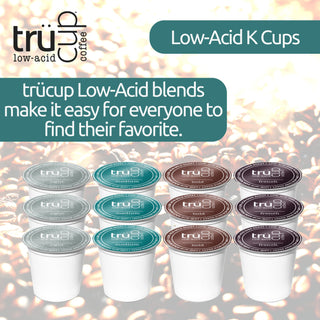
They also offer single-serve cups for Keurig, which is worth noting because switching coffee is a lot easier to commit to when you can try it in the format you're already using.
If you want to start small, samples are available. This is a simple, inexpensive way to find out whether lower-acid coffee makes a difference for you before committing to a full bag.
Tips for Drinking Coffee with Acid Reflux
Even with low-acid coffee, a few habits can make a real difference in whether you stay comfortable.
Don't drink on an empty stomach. There's nothing to buffer the acid, and your stomach lining is more exposed. Even a small amount of food first helps.
Stay upright after your cup. Lying down within two to three hours of drinking coffee is one of the most reliable ways to trigger reflux, regardless of what you're drinking. Gravity matters.
Watch the add-ins. Cream and certain artificial sweeteners are independent reflux triggers for some people. If you switched to low-acid coffee and still have symptoms, the culprit might be what you're putting in it.
Limit to one or two cups. Acid load is cumulative. One low-acid cup may be fine; three may not be, even if each cup is easier on its own. Start with one and see where your threshold is.
Consider half-caff if caffeine is also a trigger. If you suspect caffeine (not just acid) is contributing to your symptoms, a half-caff option lets you cut caffeine by half without going fully decaf. It's a reasonable middle ground while you're sorting out what's actually causing the problem.
Frequently Asked Questions
Can I drink coffee with GERD? Many people with GERD can, especially with low-acid coffee. The degree to which coffee affects GERD varies from person to person. Some people find that switching to a lower-acid variety eliminates the problem; others need to also reduce caffeine or adjust when they drink it. It's worth experimenting before assuming you have to quit entirely.
What is the best coffee for heartburn? Low-acid coffee that's been tested for pH. Not all brands that call themselves "low acid" have the lab data to back it up. trücup has been independently tested for over 10 years at 5.74 pH, about 60% less acidic than conventional coffee, which puts it among the most stomach-friendly options you can find.
Is decaf better for acid reflux? It can be, but not automatically. Decaf removes caffeine (which relaxes the esophageal sphincter), but decaf coffee can still be highly acidic depending on the bean and processing. If you're switching to decaf to manage reflux, choosing a low-acid decaf covers both variables.
What's the worst coffee for acid reflux? Hot-brewed light roast, drunk on an empty stomach. Light roasts retain more chlorogenic acid. Hot brewing extracts more acid than cold. An empty stomach means nothing buffering the contact. Stack all three and you have the ideal conditions for reflux. Avoiding any one of those factors helps; avoiding all three helps more.
Can I ever drink coffee again if I have GERD? For most people, yes. GERD doesn't necessarily mean permanent coffee abstinence. It means being more thoughtful about what you're drinking and when. Low-acid coffee, combined with a few timing adjustments, lets most people with GERD keep coffee in their life without daily symptoms.
Does quitting coffee help acid reflux? It often does, because you've removed the trigger. But quitting isn't the only option. Switching to low-acid coffee removes most of the triggers while letting you keep the ritual. For people who genuinely can't give up coffee, it's a reasonable first step.
If you've spent time being told that coffee and acid reflux are simply incompatible, it's worth testing that assumption before you accept it. A lot of people find they didn't need to quit. They just needed a cup that wasn't working against them.
Try a trücup sample and find out if lower acid is the variable that makes the difference.